
Patios, lanai extensions and walkways
Concrete Patios in Port St. Lucie, FL
More usable outdoor space, sloped to shed summer downpours and finished to stay comfortable in the sun.
- Free estimate at the property: measurements, drainage and the culvert checked
- Itemized written price for base, thickness, steel, finish and sealing
- Permit and stakeout timing built into the schedule before a pour is booked
Outdoor Space You Can Use Most of the Year
Concrete Patios get used year-round in Port St. Lucie, where the Fort Pierce weather normals show average highs in the 70s even in January. Yet many homes, especially those built in the 2000s, came with a small slab under a covered lanai and not much else. A patio extension turns that into room for a table, a grill, an outdoor kitchen or a sitting area off the screen enclosure, and it adds usable living space without adding a room.
Common patio projects
- Lanai extensions: extending the slab beyond the covered area so the outdoor space is bigger than the roof
- Stand-alone patios: a slab out in the yard for a fire pit, seating or a shade structure
- Grill and outdoor kitchen pads: a thicker area sized for the weight of a built-in kitchen or counters
- Walkways and side yard paths: concrete from the driveway to the back gate, or along the side of the house where grass will not grow
- Replacing pavers or old slabs: removing a sunken paver area or a cracked slab and pouring new
Slope and drainage come first
With about 51 inches of rain a year and frequent summer storms, a patio that holds water becomes a slippery, algae-stained problem, and one that slopes toward the house sends water against the wall. We set a fall of about 1/8 to 1/4 inch per foot away from the house and plan where that water goes next, whether that is the lawn, a swale or a drain. Where a new slab meets an existing lanai slab, we match the slope and use an isolation joint so the two move independently.
Ground prep on sandy lots
Sandy Florida soil can be easy to dig but must be compacted properly, and any dark organic layer or old roots should come out first. We dig to firm ground, add compacted base, and keep downspouts and irrigation from soaking the edges of the slab. A patio that settles at one corner is almost always a base or drainage problem, not a concrete problem.
Finishes that work barefoot
Patios here are walked on barefoot, wet and in direct sun, so the finish matters more than in a cooler place.
- Broom finish: simple, grippy and the lowest cost
- Exposed aggregate: textured, hides dirt and offers good grip
- Stamped or stained: pattern and color that look like stone or tile; see our stamped concrete page
- Light colors: lighter concrete stays cooler underfoot than dark tints
A sealer helps resist staining from grills, leaves and mildew, which grows readily in humid weather.
Thickness and reinforcement
Most patios are 4 inches thick with rebar or wire mesh. If you plan an outdoor kitchen, a hot tub, or columns for a future roof, the slab under them needs to be thicker or have footings. Tell us your plans during the estimate so we build for the load, not just for today.
Permits and HOA approval
Whether a backyard patio needs a permit depends on where you live and what else is part of the job, such as a roof, screen enclosure or plumbing. We check the requirements for your address. In HOA communities, get architectural approval before the pour; many associations want to see the size and finish first. The City's 80% impervious-area limit on residential lots is also worth keeping in mind on a large addition.
Caring for a new patio
Keep furniture and grills off for several days, and avoid heavy loads until the concrete has cured. Rinse off leaves and pool chemicals rather than letting them sit. If the patio is sealed, plan to reseal every few years when water stops beading on the surface.
Patio Options
Choose the size, shape and finish; we handle the base, slope and joints.
Lanai extensions
Extending an existing covered slab out into the yard, with an isolation joint between old and new.
Stand-alone patios
Freestanding slabs for seating, fire pits or shade structures, anywhere in the yard.
Outdoor kitchen pads
Thicker slabs sized for counters, grills and built-in appliances.
Walkways and side paths
Paths from the driveway to the gate, around the house or to a shed.
Decorative finishes
Broom, exposed aggregate, stain or stamped patterns, with optional sealing.
Typical Concrete Patio Costs
| Patio | Published range |
|---|---|
| Plain concrete (per sq ft) | $4 to $12 |
| Broom finish (per sq ft) | $6 to $13 |
| Exposed aggregate (per sq ft) | $7 to $18 |
| Stained (per sq ft) | $8 to $25 |
| 10' x 10' plain (100 sq ft) | $400 to $1,200 |
| 12' x 12' plain (144 sq ft) | $600 to $1,700 |
| 16' x 16' plain (256 sq ft) | $1,000 to $3,100 |
| 20' x 20' plain (400 sq ft) | $1,600 to $4,800 |
National ranges from HomeGuide's concrete patio cost guide (the paver comparison in the FAQ is from its stamped concrete patio guide). Your price depends on size, access, tear-out and finish. Your written estimate is the price.
How a Patio Gets Built
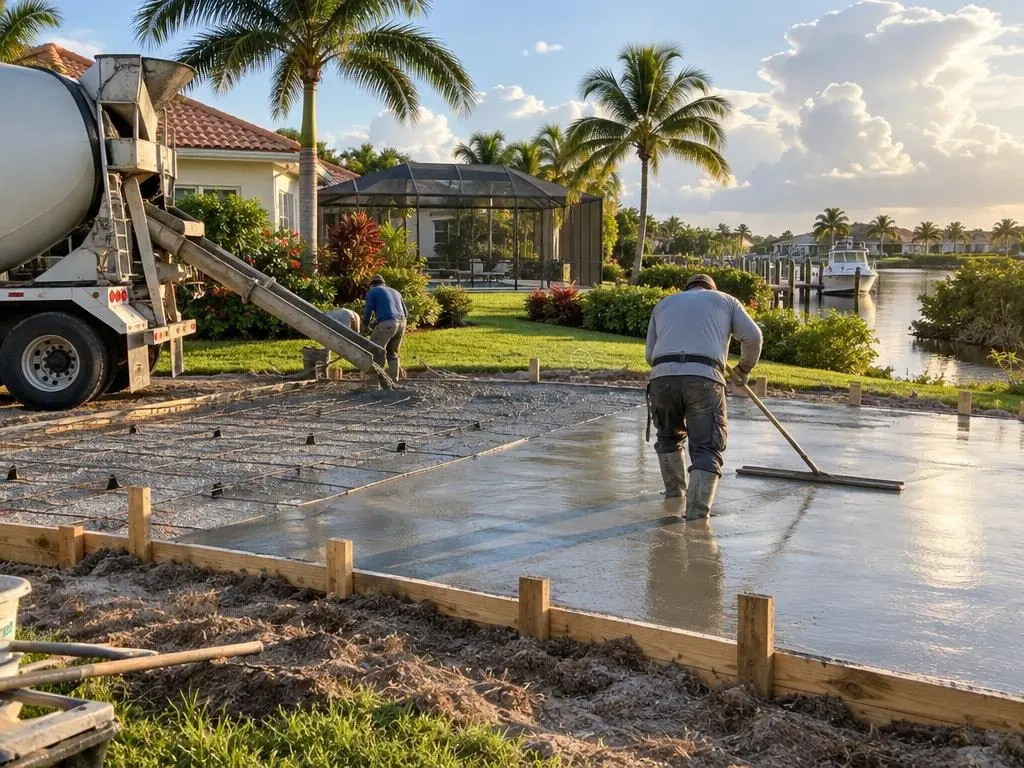
1. Lay it out
We mark the shape on the ground, check where water drains and talk through furniture, grills and future plans.
2. Dig and base
Sod, roots and soft soil come out, and base is compacted to a firm, sloped grade.
3. Forms and steel
Forms set the shape and fall; rebar or mesh goes in, with isolation joints at the house or old slab.
4. Pour, finish and cure
We pour, finish to your choice, cut joints and start curing, then tell you when to move furniture back.
Concrete Patios Questions
How much does a 12x12 concrete patio cost?
HomeGuide lists $600 to $1,700 for a plain 12x12 patio and $1,150 to $4,300 with a stained or stamped finish. Tear-out of an old slab, extra base or a difficult access path adds to the cost.
Can you extend the slab under my lanai?
Yes. We pour the new section next to the existing slab with an isolation joint, matching the height and slope so water still runs away from the house. If you plan to extend the roof or screen later, we size the edge to carry it.
Is concrete or pavers better for a patio?
HomeGuide's stamped concrete patio guide puts paver patios at $10 to $17 per square foot installed, and its concrete patio guide lists plain concrete at $4 to $12. Pavers can be lifted and reset if the ground moves; concrete is a single, easier-to-clean surface with no joints for weeds or ants.
How long before I can use my new patio?
You can usually walk on it after a day or two. Wait several days before moving heavy furniture or grills onto it, and longer before anything very heavy, while the concrete continues to cure.
Concrete Patios Service Areas
- Concrete Contractors in Port St. Lucie, FL
- Concrete Contractors in Tradition, FL
- Concrete Contractors in St. Lucie West, FL
- Concrete Contractors in Fort Pierce, FL
- Concrete Contractors in Stuart, FL
- Concrete Contractors in Jensen Beach, FL
- Concrete Contractors in Palm City, FL
- Concrete Contractors in Hobe Sound, FL
- Concrete Contractors in Port Salerno, FL
- Concrete Contractors in Sewall's Point, FL
- Concrete Contractors in River Park, FL
- Concrete Contractors in Lakewood Park, FL
- Concrete Contractors in Fort Pierce North, FL
- Concrete Contractors in Fort Pierce South, FL
- Concrete Contractors in Indian River Estates, FL
- Concrete Contractors in St. Lucie Village, FL
- Concrete Contractors in Hutchinson Island South, FL
- Concrete Contractors in Indiantown, FL
- Concrete Contractors in North River Shores, FL
- Concrete Contractors in Rio, FL
- Concrete Contractors in Jupiter Island, FL
Get a Concrete Patios Estimate
Tell us the size you have in mind and how you want to use it, and we will quote the patio.