
New, replacement and widened driveways
Concrete Driveways in Port St. Lucie, FL
Sized for the way your household parks, poured on a firm base, and tied into the swale and culvert correctly.
- Free estimate at the property: measurements, drainage and the culvert checked
- Itemized written price for base, thickness, steel, finish and sealing
- Permit and stakeout timing built into the schedule before a pour is booked
Driveways That Cross the Swale Without Settling
Concrete Driveways in Port St. Lucie do more than carry the car to the garage. On most lots the driveway also crosses City right of way, often over a culvert pipe, and that crossing is where many older driveways crack, sink or break up first. A new driveway has to work with that pipe, with the slope from the garage to the road, and with sandy ground that softens when it stays wet in the rainy season.
Three common driveway jobs
- Replacement: removing an old, cracked driveway, often original to a 1980s or 1990s home, and pouring a new one on a fresh base
- Widening: adding a strip along one or both sides so two cars, a boat trailer or an extra vehicle fit side by side
- Second or circular driveway: a new curb cut and approach, which needs its own permit review for setbacks and impervious area
The City part of the job
The City of Port St. Lucie Public Works Department reviews driveway modifications through a Residential Driveway Modification Permit. It covers changing the width, replacing or reusing the culvert pipe, switching the surface to concrete or pavers, repairing the existing driveway and adding a second or circular driveway. The application states that the culvert pipe may need to be replaced or brought up to code, and it lists three inspections: culvert stakeout, driveway and final. Stakeouts typically take 4 to 6 weeks after the request, so we file early and set the pour date around it. The same form limits driveways to no closer than 6 feet from a side lot line, 10 feet from a rear lot line next to another lot and 20 feet next to a canal or waterway, and caps impervious area at 80% of the lot. If a public sidewalk crosses your driveway, it must stay concrete and keep its slope and finish to meet ADA requirements.
What goes under the concrete
Driveways almost always fail from below. We excavate to firm soil, pull out dark organic material and roots, and bring in base that is compacted in layers. On sand, that base plus a steady pitch keeps rainwater from running beneath the slab and washing out its support. The apron gets extra care because it is where heavy tires, a buried pipe and a grade change all meet.
Thickness, steel and joints
Four inches is the usual thickness for cars. Pickups, boat trailers and RVs are better served by 6 inches, which HomeGuide also suggests for heavy vehicles. Rebar or welded wire holds any crack tight, and saw-cut control joints at the proper spacing give the slab a straight, planned place to crack instead of a jagged line across a panel.
When a driveway is due for replacement
- Cracks over roughly 1/4 inch wide, or cracks where one edge sits higher
- Panels that have dropped, most often at the garage door or over the culvert
- Wide patches of scaling, crumbling or exposed stone
- Puddles that sit after a storm, or runoff heading toward the garage
- A width that no longer fits the cars the household owns
When only a panel or two is bad, replacing or lifting those may be enough. The concrete repair page covers those options.
Finishes and color in the Florida sun
Broom texture is the default because it gives tires and shoes traction on wet concrete, and wet concrete is common here in summer. Plain light gray bounces back more sunlight than a dark surface. Exposed aggregate or a stamped border adds looks and grip. For color, pigment mixed into the whole batch holds up better in strong sun than a surface-only tint, and sealer keeps it from looking washed out.
Timing and the first month
In hot months we pour at dawn and work around the afternoon storm cycle. HomeGuide's timeline is 24 to 48 hours before walking on it, at least 7 days before cars, and the full 28 to 30 day cure before heavy trucks. Keep sprinklers off it for the first several days and avoid parking right at the edges, the weakest part of a new slab. Sealer, if you want it, goes on once curing is complete.
What a Driveway Job Covers
Each driveway quote breaks the job into these pieces so the cost of every part is visible.
Tear-out and haul-away
Breaking up the existing driveway or apron and hauling the rubble off the property.
Culvert and apron work
Working with the City permit, stakeout and inspections when the pipe under the driveway needs replacing or upgrading.
Base and grading
Removing soft or organic soil, adding compacted base and setting slope to the street and away from the garage.
Widening and extensions
Adding side strips, parking pads or a second approach within the City setback and impervious-area limits.
Reinforcement and joints
Rebar or wire mesh, plus control joints cut at the right spacing and depth.
Finish and sealing
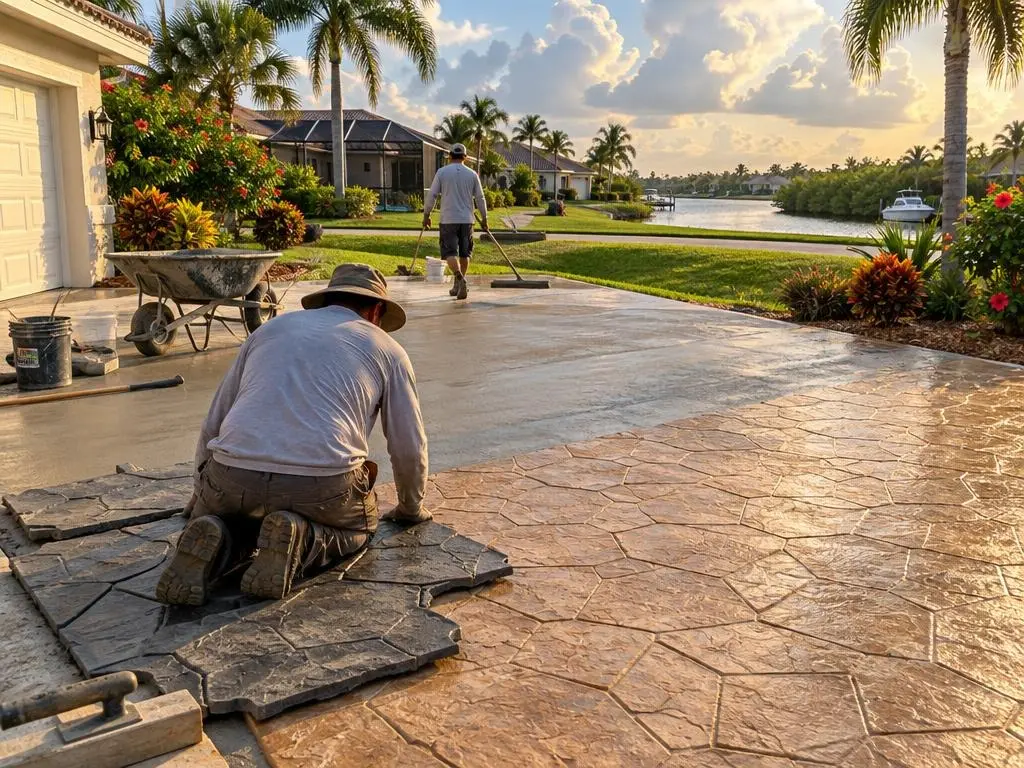
Broom, exposed aggregate or decorative borders, with optional sealing after cure.
Typical Concrete Driveway Costs
| Item | Published range |
|---|---|
| Standard driveway, installed (per sq ft) | $6 to $10 |
| One-car, 12' x 24' (288 sq ft) | $1,700 to $4,300 |
| Two-car, 24' x 24' (576 sq ft) | $3,500 to $8,600 |
| Three-car, 24' x 36' (864 sq ft) | $5,200 to $13,000 |
| 6-inch slab for heavy vehicles (per sq ft) | $8 to $20 |
| Rebar reinforcement (per sq ft) | $1 to $3 |
| Old driveway removal (per sq ft) | $2 to $6 |
| Permit (varies by location) | $50 to $200 |
National ranges from HomeGuide's concrete driveway cost guide. Port St. Lucie prices depend on tear-out, culvert work, thickness, finish and access. Your written estimate is the price.
How a Driveway Gets Built
1. Measure and plan
We measure, check the fall from garage to street, look over the culvert and ask what you park and where.
2. Permit and stakeout
We prepare the City driveway paperwork and schedule around the culvert stakeout and inspections.
3. Dig, base and forms
The old slab comes out, soft soil is dug away, base is compacted, then forms and steel are set.
4. Pour, finish and cure
We pour early, finish, cut joints and start curing, then give you dates for walking and driving.
Concrete Driveways Questions
How much does a 20x40 concrete driveway cost?
At 800 square feet and HomeGuide's $6 to $10 per square foot for a standard driveway, expect roughly $4,800 to $8,000 before removal, culvert work or permits. A 6-inch slab or a decorative surface costs more.
Does widening a driveway in Port St. Lucie need a permit?
Yes. Width changes are one of the items on the City of Port St. Lucie Public Works Department's Residential Driveway Modification Permit, together with culvert replacement, surface changes, repairs and second driveways. The stakeout alone typically takes 4 to 6 weeks, so it pays to start early.
Will I need a new culvert pipe?
Sometimes. The City's application says the culvert pipe may need to be replaced or brought up to code when a driveway is modified. We look at the pipe during the estimate and include it in the quote if it is needed.
How thick should a driveway be?
Four inches is standard for cars. For trucks, boat trailers or RVs, a 6-inch section is the safer choice, and HomeGuide recommends it for heavy vehicles.
What is the lifespan of a concrete driveway?
HomeGuide estimates 30 to 40 years with good maintenance. A solid base, water directed away from the slab and periodic sealing all help it get there.
Concrete Driveways Service Areas
- Concrete Contractors in Port St. Lucie, FL
- Concrete Contractors in Tradition, FL
- Concrete Contractors in St. Lucie West, FL
- Concrete Contractors in Fort Pierce, FL
- Concrete Contractors in Stuart, FL
- Concrete Contractors in Jensen Beach, FL
- Concrete Contractors in Palm City, FL
- Concrete Contractors in Hobe Sound, FL
- Concrete Contractors in Port Salerno, FL
- Concrete Contractors in Sewall's Point, FL
- Concrete Contractors in River Park, FL
- Concrete Contractors in Lakewood Park, FL
- Concrete Contractors in Fort Pierce North, FL
- Concrete Contractors in Fort Pierce South, FL
- Concrete Contractors in Indian River Estates, FL
- Concrete Contractors in St. Lucie Village, FL
- Concrete Contractors in Hutchinson Island South, FL
- Concrete Contractors in Indiantown, FL
- Concrete Contractors in North River Shores, FL
- Concrete Contractors in Rio, FL
- Concrete Contractors in Jupiter Island, FL
Get a Concrete Driveways Estimate
Tell us the size and what you park, and we will quote the driveway, the apron and the permit work.